
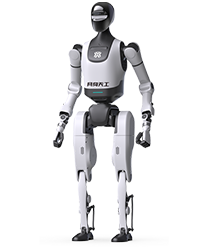
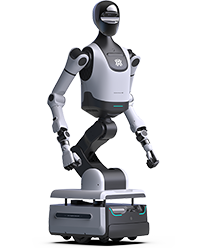
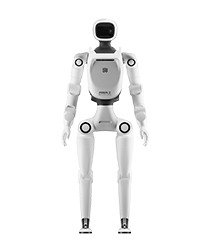




At the World Humanoid Robot Games, TianGong Ultra broke the 100-meter record in 8.64 seconds, drawing intensive coverage from mainstream international media, and the X- Humanoid continues to attract high global media attention.
Reuters, a globally leading news organization, made a special visit to the X- Humanoid for an in-depth conversation with Jack Guo (Guo Yijie), head of the humanoid innovation department at X- Humanoid, to discuss the development story behind this robot that "outruns Bolt."
The following are the key points of Reuters’ visit and report.
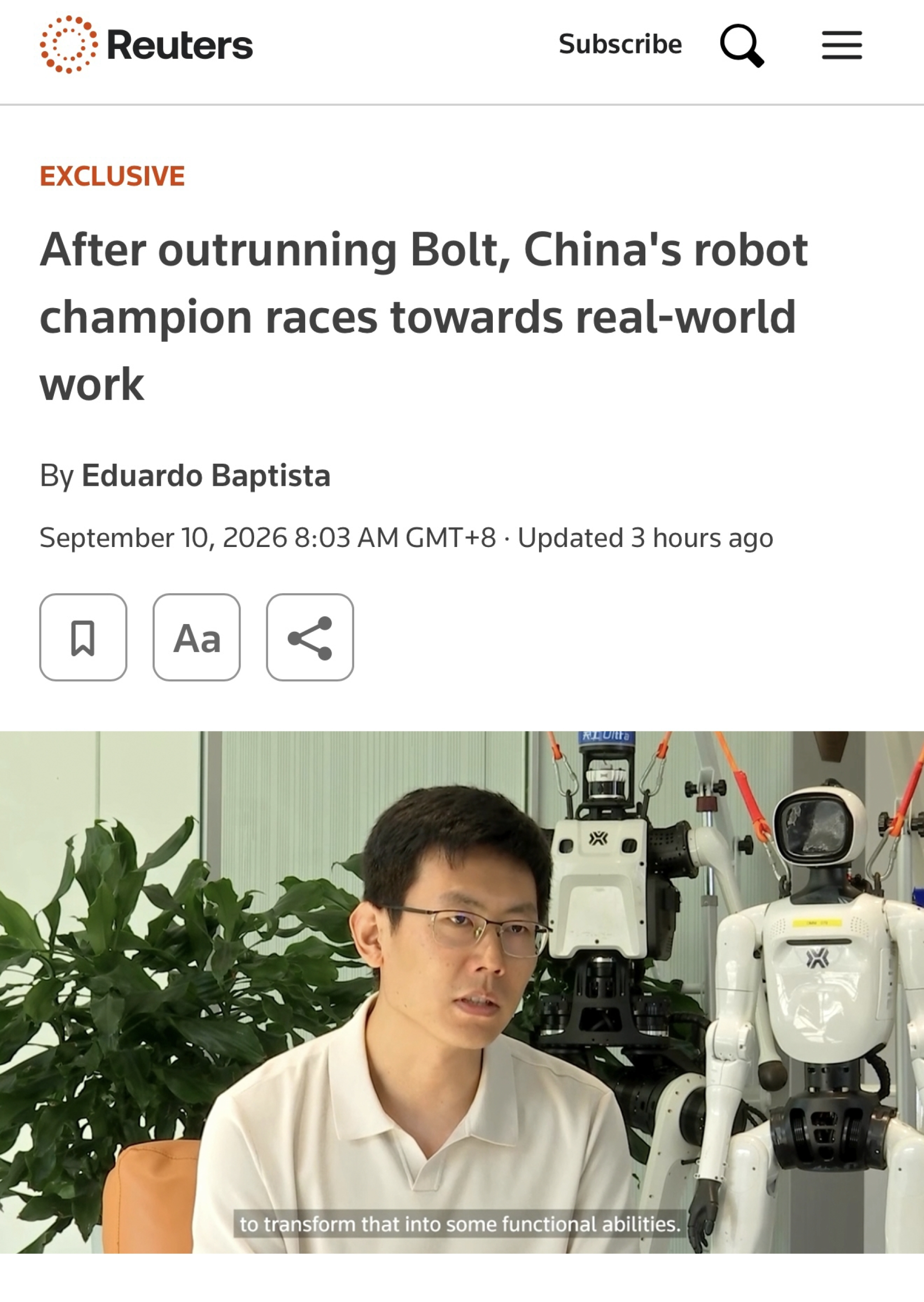
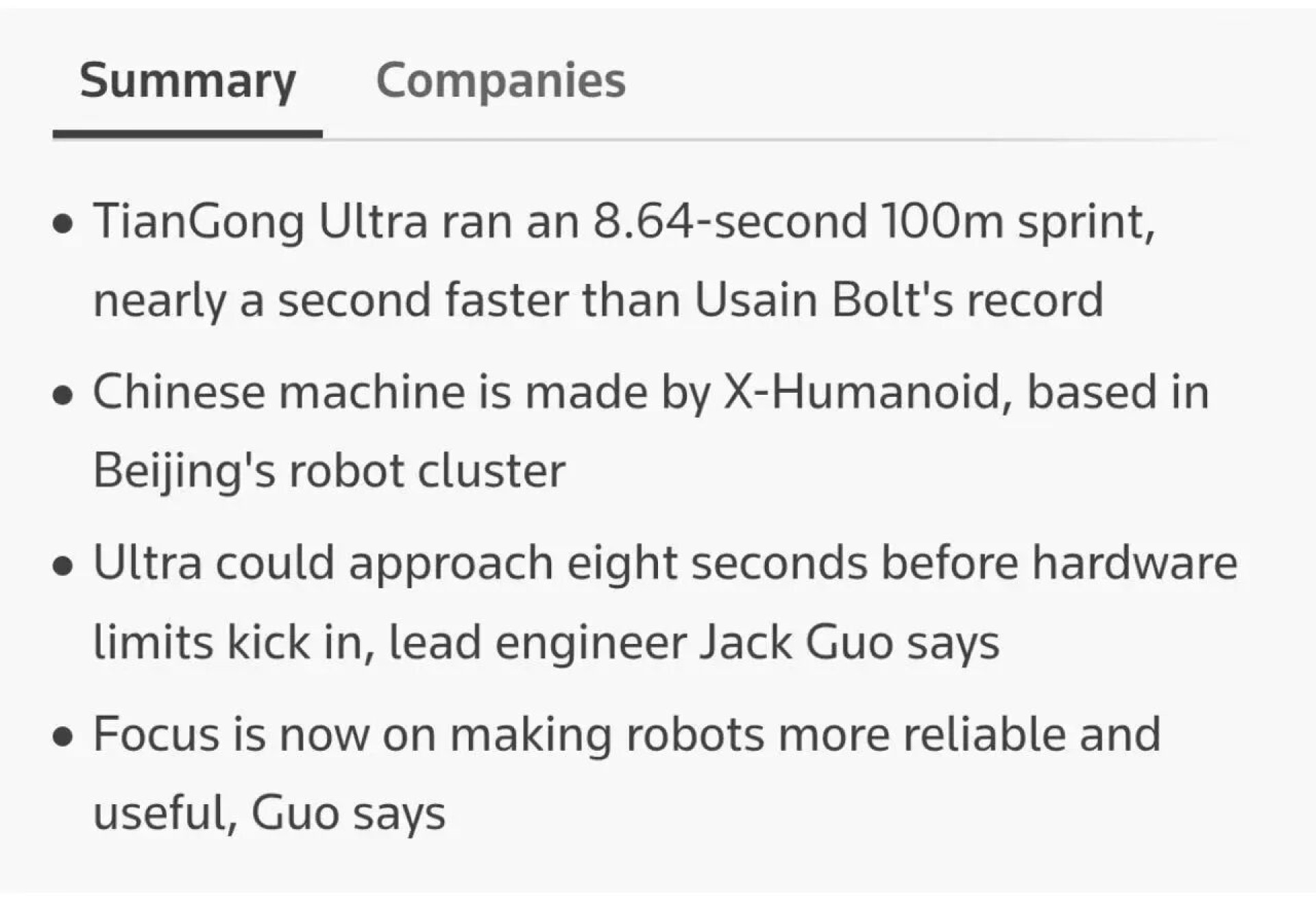
BEIJING, Sept 10 (Reuters) - A week after the TianGong Ultra robot outran the fastest human sprinter, Jack Guo is already chasing a harder target.
At the World Humanoid Robot Games, TianGong Ultra stunned the audience by running 100 meters in 8.64 seconds, nearly a full second faster than Bolt’s world record. Behind this feat were days and nights of relentless testing and emergency repairs on damaged robots between competitions.
"When it successfully started and crossed the 50-meter mark, I finally breathed a sigh of relief," said Jack Guo (Guo Yijie), who leads the development of TianGong Ultra and TianGong Omni at X- Humanoid. Just a week later, the bespectacled 34-year-old engineer had already set his sights on a bigger challenge.

"We hope to translate high performance into high reliability and high practicality," he told Reuters in his first interview with foreign media.
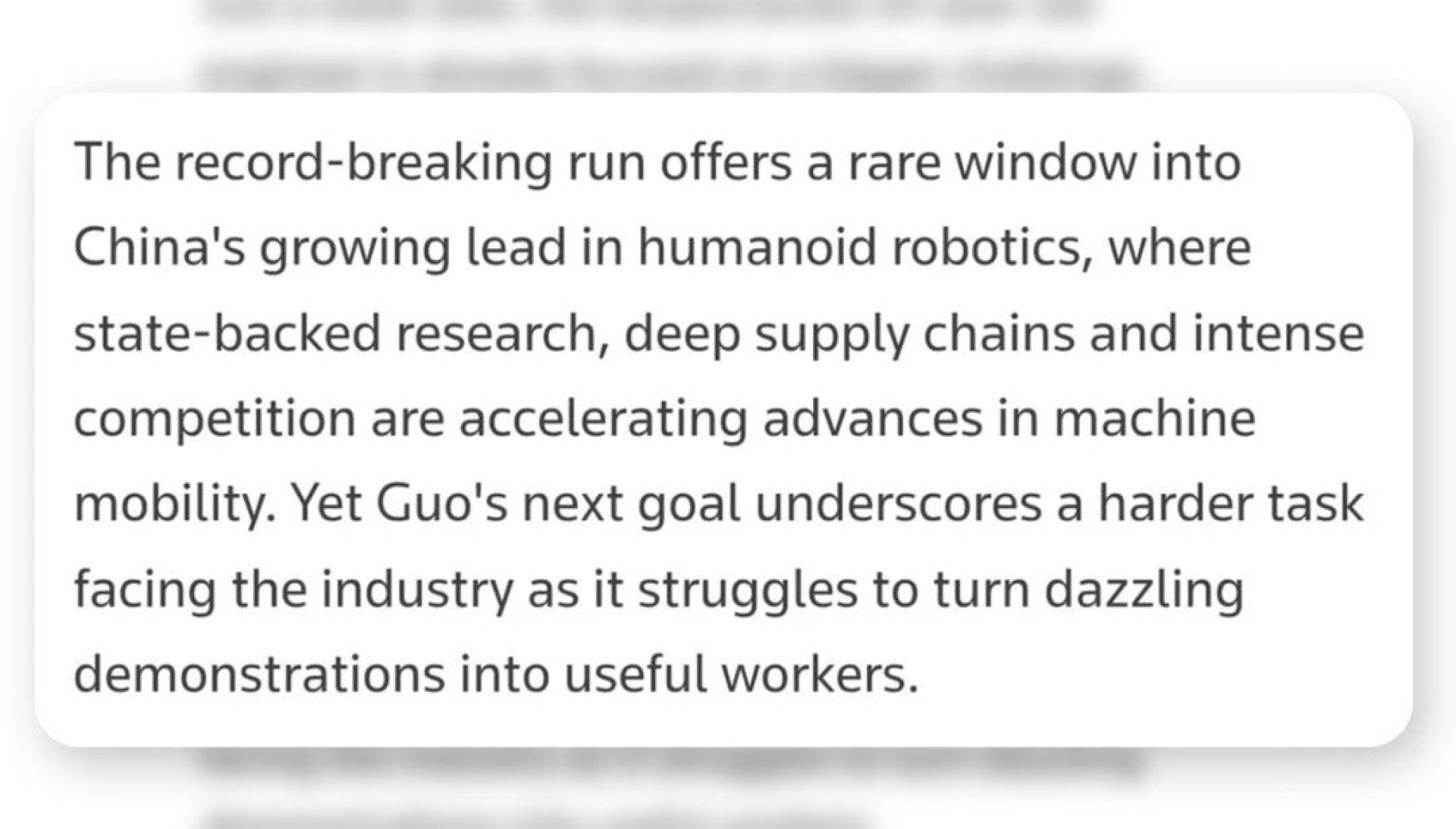
This record-breaking run offered a rare window into China’s expanding lead in humanoid robotics — state-backed research, a deep supply chain and fierce competition are accelerating progress in machine locomotion. Yet Jack Guo’s next goal also highlights the harder task facing the industry: turning dazzling demos into genuinely useful workers.
X- Humanoid is located in the Yizhuang high-tech development zone in southeastern Beijing. In the company’s first-floor exhibition hall, generations of TianGong robots are on display, one of which is still wearing the vest it wore when it won a half-marathon last year.
During Reuters’ visit, engineers were repairing and testing robots: some were removing head casings, some were tightening legs, and others were conducting walking tests. In the adjacent office, Jack Guo’s team develops software first, then tests it on physical machines.
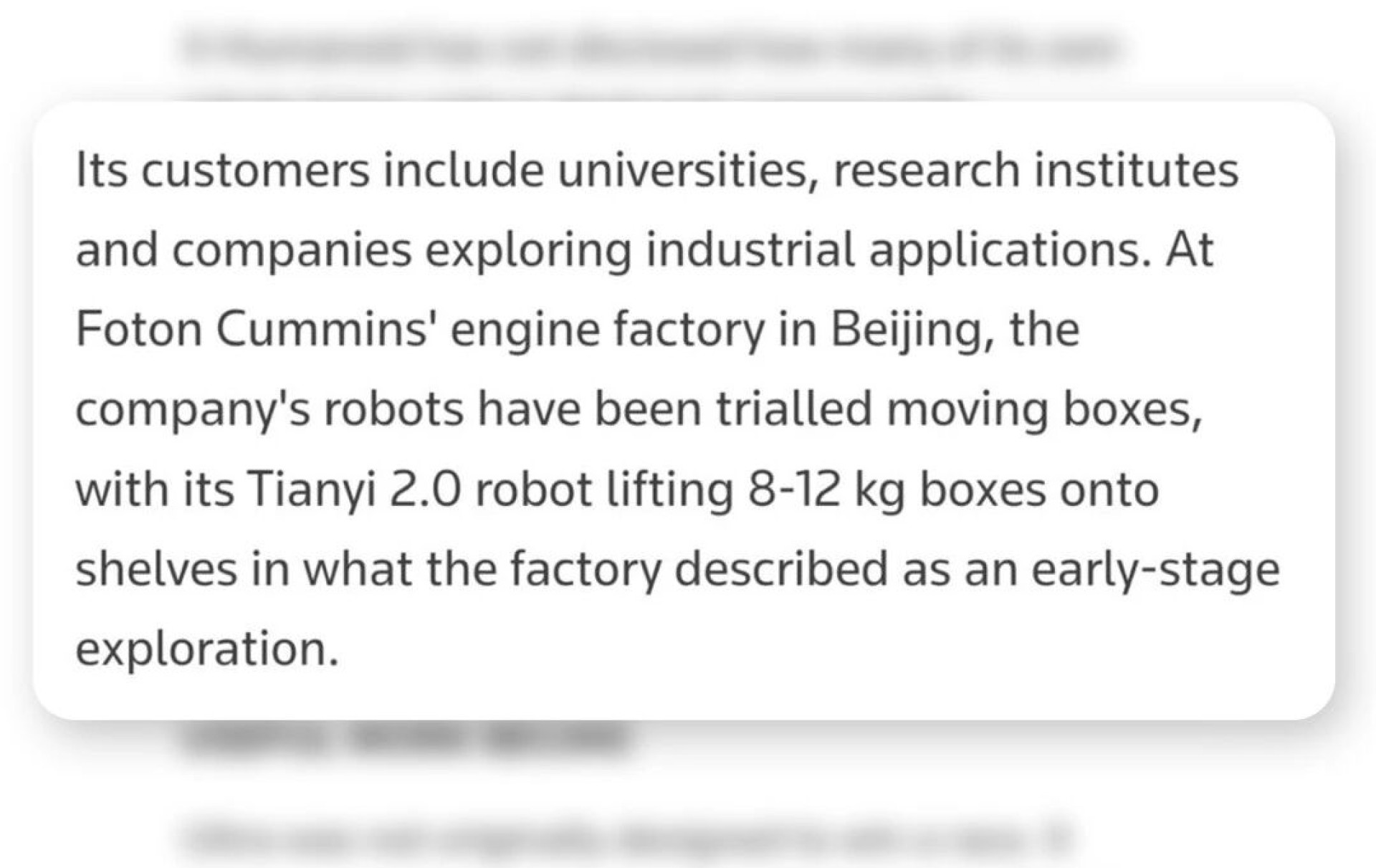
X- Humanoid was founded in November 2023. The company develops hardware, motion control software and artificial intelligence for the broader industry, while commercializing its own robots. Its customers include universities, research institutions and enterprises exploring industrial applications. At the Beijing Foton Cummins engine plant, the company’s robots have been tested moving boxes — the Tian Yi 2.0 robot lifts 8-12 kg boxes onto shelves, which the plant calls an early exploration.
Ultra was not originally designed to win a race; it began as an experiment to push the limits of humanoid robot locomotion.
Jack Guo (Guo Yijie) likens today’s humanoid robots to the earliest automobiles: first make them controllable, then pair a reliable body with a smarter AI "brain" so they can handle complex tasks independently.

He said the current challenge is to keep the robot’s body and motion control system stable and reliable in daily use. Developing the AI needed for more complex autonomous tasks will take longer; teaching robots to run can cultivate general locomotion capabilities and improve their ability to handle different terrains.
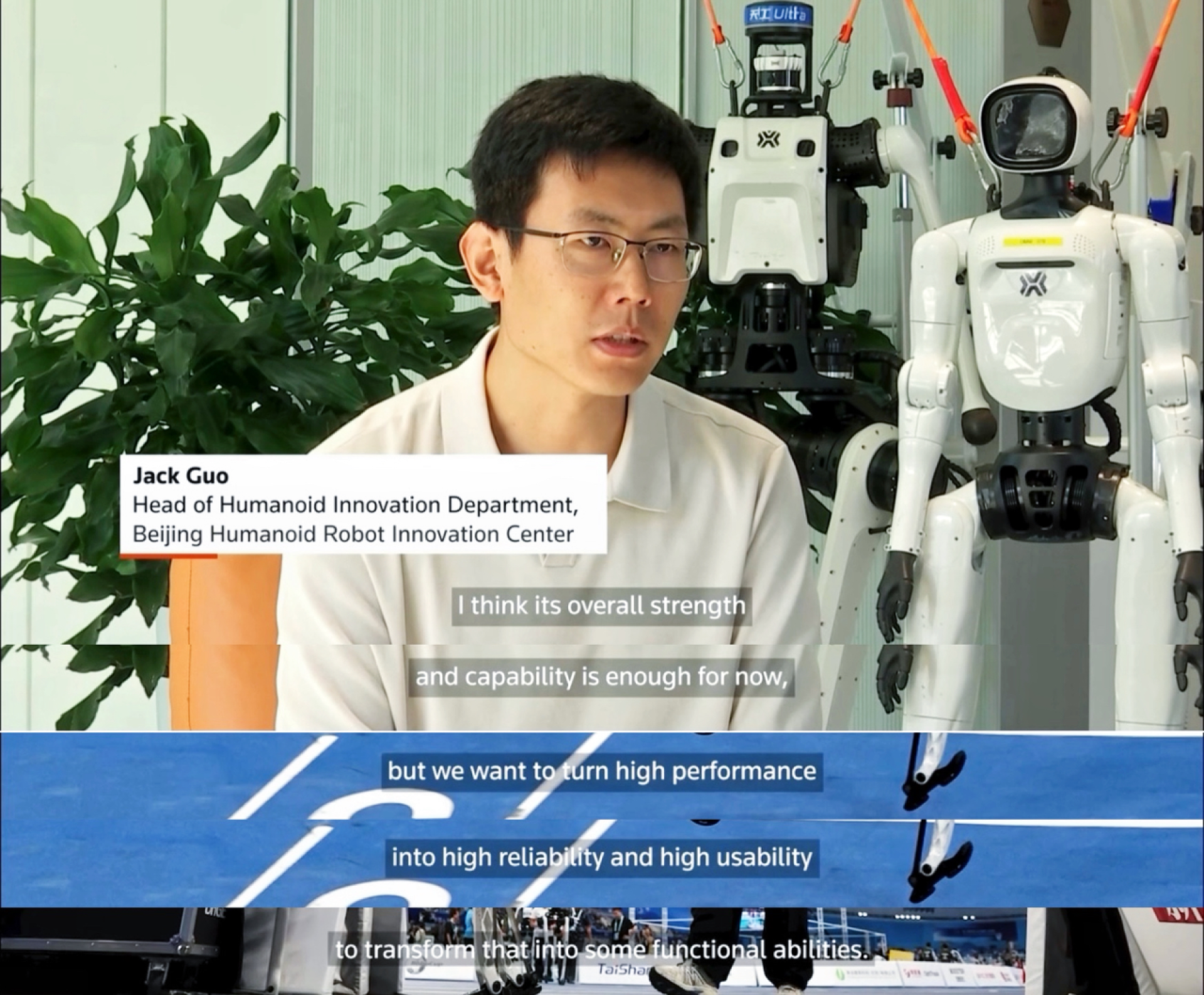
The smaller TianGong Omni has already demonstrated what this means in practice. In an internal test this year, it climbed from the first floor to the 17th floor at X- Humanoid headquarters. Jack Guo (Guo Yijie) expects that smaller humanoid robots will be the first to find use in commercial services and light industry, while TianGong Ultra may eventually perform outdoor inspection or emergency rescue tasks.

TianGong Ultra came to the track with three running strategies trained in simulation. One had been battle-tested, while the other two were theoretically faster but less verified. Each strategy is a trained motion control system that continuously adjusts joints and balance, enabling the robot to sprint upright without an operator directing every step.
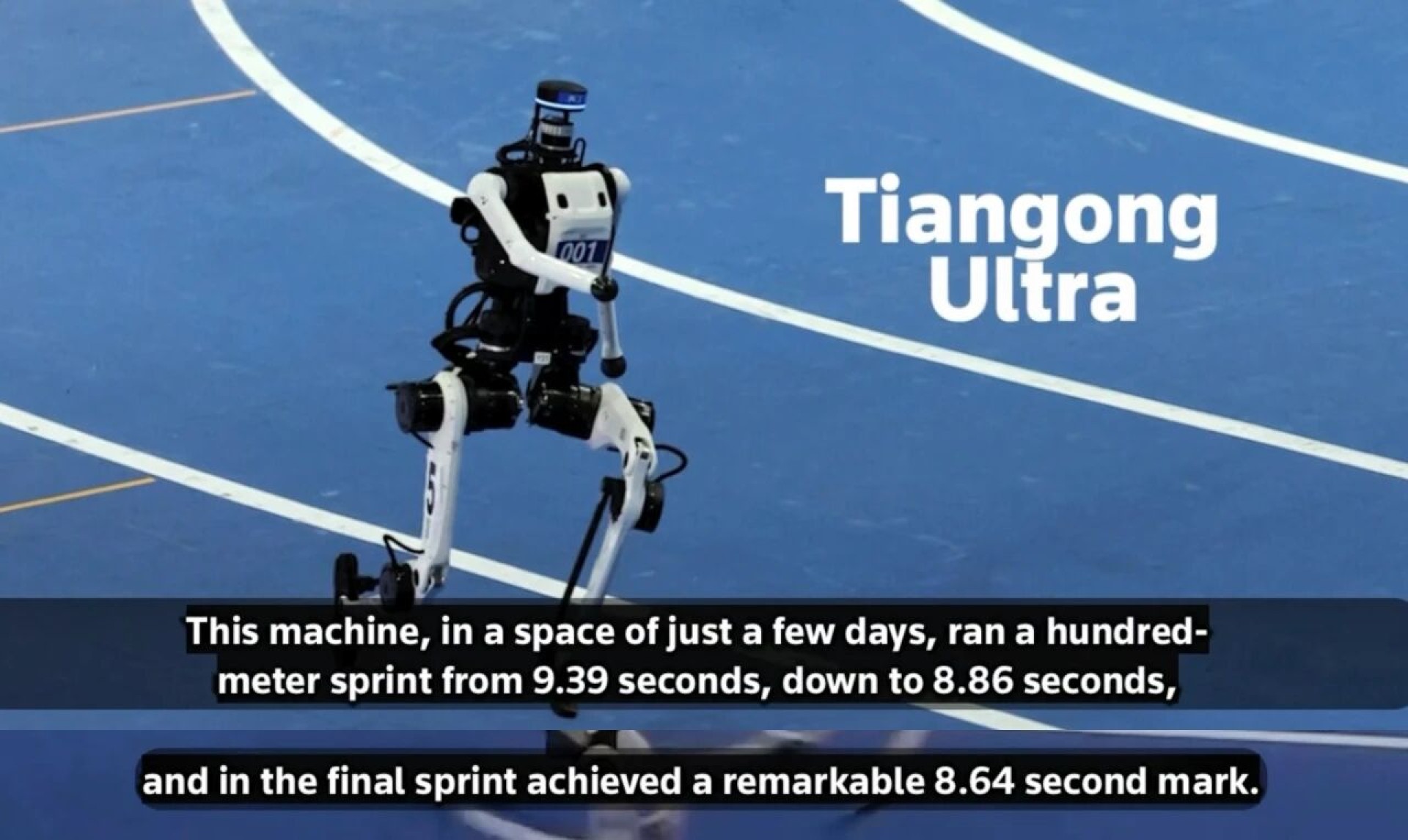 TianGong Ultra used a different program in each race: 9.39 seconds in the preliminary round, 8.86 seconds in the semifinal, and 8.64 seconds in the final. Between races, engineers returned to the test site to test faster programs more aggressively and adjust navigation and running control. The engineers stayed up several consecutive nights, sometimes testing until the next day before returning to the venue.
Even on the morning of the final, the team was still testing a newly trained running program. It succeeded repeatedly in trials, but conditions on the race track were different, and variations between individual robots also posed a challenge.
TianGong Ultra’s heavier legs limited its early acceleration, but once its speed exceeded about 10 meters per second, it could keep accelerating and catch up with its opponents. By the semifinals, the team had cut its starting reaction time by about half a second. After that, attention shifted to absolute speed.
In the final, faster reaction times and late-stage acceleration enabled TianGong Ultra to complete more decisive overtakes.
At the closing ceremony, a row of TianGong humanoid robots donned red capes printed with the word "Champion," and some waved pom-poms. This was Team TianGong celebrating their victory.


 京公网安备11011202100775号